
Why Engagement Is a Comfort Metric (and Why It Fails at Scale)

Part 1 of a series on measuring real ROI in influencer marketing.
Every marketer has been there. You launch an influencer campaign, the content goes live, and within hours you're watching the numbers climb. Likes pour in. Comments stack up. The engagement rate hits 4%, then 5%, then 6%. Your client or executive asks how it's going, and you confidently report: "Engagement is really strong."
Everyone nods. Everyone feels good. And that's precisely the problem.
Engagement has become the default success metric in influencer marketing not because it's the most meaningful measure of business impact, but because it's the easiest to access, the quickest to report, and the most psychologically satisfying to share. It's a comfort metric, a number that makes stakeholders feel like something is working without necessarily proving that it is. And while engagement isn't worthless, treating it as a proxy for ROI creates a fundamental misalignment between what you're measuring and what actually matters to your business.
This is the first article in a series about measuring real ROI in influencer marketing. Before we can build better measurement systems, we need to understand why the current standard falls short and what happens when brands try to scale campaigns built on engagement-focused thinking.
The Appeal of Engagement: Why We Reach for It
Engagement metrics, likes, comments, shares, saves, are seductive for good reason. They're immediate, abundant, and platform-native. Unlike revenue attribution or customer acquisition cost, you don't need complex tracking infrastructure to see them. They appear in real-time as social proof that your content resonated. For brand managers operating in environments where executives demand quick updates and tangible evidence of activity, engagement provides an answer that feels concrete.
There's also a kernel of truth in engagement's utility. High engagement can signal that content is resonating with an audience, that the creator's community is active and attentive, that the message isn't being ignored. In the early stages of a campaign or when testing new creators, engagement can offer useful signals about content quality and audience responsiveness.
But here's where the logic breaks down: engagement measures attention and reaction, not business outcomes. A piece of content can generate thousands of likes from an audience that will never buy your product. Comments can reflect controversy or confusion rather than purchase intent. Shares might spread your brand name without moving anyone closer to conversion. Engagement tells you that people saw something and responded, but it tells you almost nothing about whether that response translates into revenue.
The Engagement-Revenue Gap: Where the Model Breaks
The core issue with engagement as a success metric is that it lives several steps removed from the outcomes that justify marketing spend. Consider the implicit chain of assumptions required for engagement to matter to your bottom line:
- High engagement means the audience is genuinely interested in the content
- Interest in the content translates to interest in the product
- Interest in the product leads to consideration and research
- Consideration leads to purchase intent
- Purchase intent converts to actual revenue
Each link in this chain represents a potential failure point where the logic can break down. An audience might engage enthusiastically with a creator's personality while remaining indifferent to the advertised product. They might be interested in the product but not ready to buy. They might intend to purchase but never follow through. The distance between a double-tap and a transaction is vast, and engagement data gives you no visibility into where the breakdown occurs.
This gap becomes especially apparent when you examine engagement across different types of content. A creator's personal life update might generate far higher engagement than a product demonstration, but the latter could drive significantly more revenue. A controversial hot take might spark intense debate in the comments, but angry engagement rarely converts to sales. By optimizing for engagement alone, you risk incentivizing content that performs well on vanity metrics while underperforming on business outcomes.
The Platform Incentive Misalignment
There's another structural problem with engagement-centric measurement: the platforms that provide these metrics have fundamentally different goals than the brands using them. Instagram, TikTok, and YouTube want to maximize time on platform and user interaction because that's what drives their advertising revenue. Their algorithms reward content that keeps people scrolling, commenting, and sharing, not content that drives external conversions.
This creates a perverse incentive. Creators optimize for what the algorithm rewards, which is engagement. Brands evaluate success using the same engagement metrics the platforms surface. But platforms have no particular interest in whether your product sells, they care whether users stay engaged with their platform. By accepting platform-provided engagement metrics as your primary KPIs, you're effectively letting Instagram or TikTok define what success means for your business, even though their definition of success and yours are not aligned.
The result is a system where everyone is optimizing for the wrong thing. Creators chase likes and comments because that's what gets their content distributed. Brands celebrate high engagement rates because that's what's easy to measure. And platforms facilitate both because engaged users are profitable users. Meanwhile, the actual business question, "Did this campaign generate more revenue than it cost?" remains largely unanswered.
What Happens When You Scale on Engagement
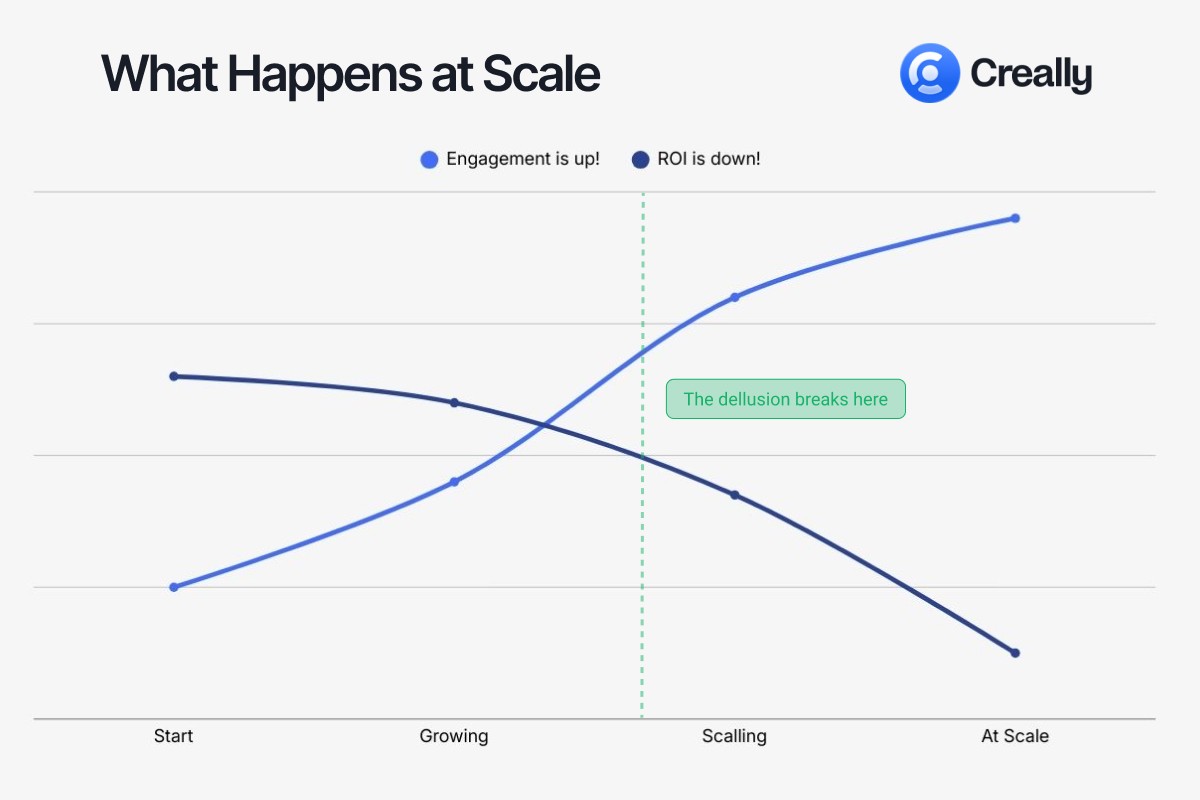
The limitations of engagement as a success metric become impossible to ignore when you try to scale influencer marketing into a meaningful revenue channel. In small-scale campaigns, the disconnect between engagement and revenue might not matter much. You're testing, learning, building relationships. A few thousand dollars spent with a handful of creators won't make or break your quarter.
But when you attempt to scale, when you try to allocate six or seven figures toward influencer marketing as a core growth channel, engagement-based measurement collapses under its own weight. You can't build a sustainable, scalable marketing system on metrics that don't correlate with revenue. Here's what typically happens:
Budget justification becomes impossible
When your CFO asks why you need to double your influencer budget, "We're getting great engagement rates" doesn't provide a compelling answer. Without a clear connection to revenue or customer acquisition, influencer marketing gets stuck in the "experimental" budget category, perpetually underfunded relative to its potential.
Optimization becomes guesswork
If you're measuring success by engagement, you'll naturally allocate more budget to creators and content types that generate the most likes and comments. But if those aren't the creators and content types that drive sales, you're systematically misallocating resources. Over time, this compounds, you get better and better at generating engagement and worse and worse at generating ROI.
Performance comparison breaks down
When engagement is your metric, how do you compare influencer marketing to paid search, email marketing, or SEO? Each channel plays a different role, but they all ultimately need to justify themselves through business impact. Engagement lives in its own incomparable universe, which makes it nearly impossible to make rational resource allocation decisions across channels.
Creator selection becomes subjective
Without revenue data, choosing which creators to work with devolves into arguments about engagement rates, audience demographics, and gut feeling about "brand fit." These factors matter, but without tying them to actual performance outcomes, you have no way to validate whether your selection criteria are correct.
The companies that have scaled influencer marketing successfully, those treating it as a seven or eight-figure revenue channel rather than an experimental tactic, have all made the same shift: they stopped measuring success through engagement and started building real attribution and revenue measurement systems. Not because engagement is meaningless, but because it's insufficient for the decisions they need to make.
The Psychological Comfort of False Precision
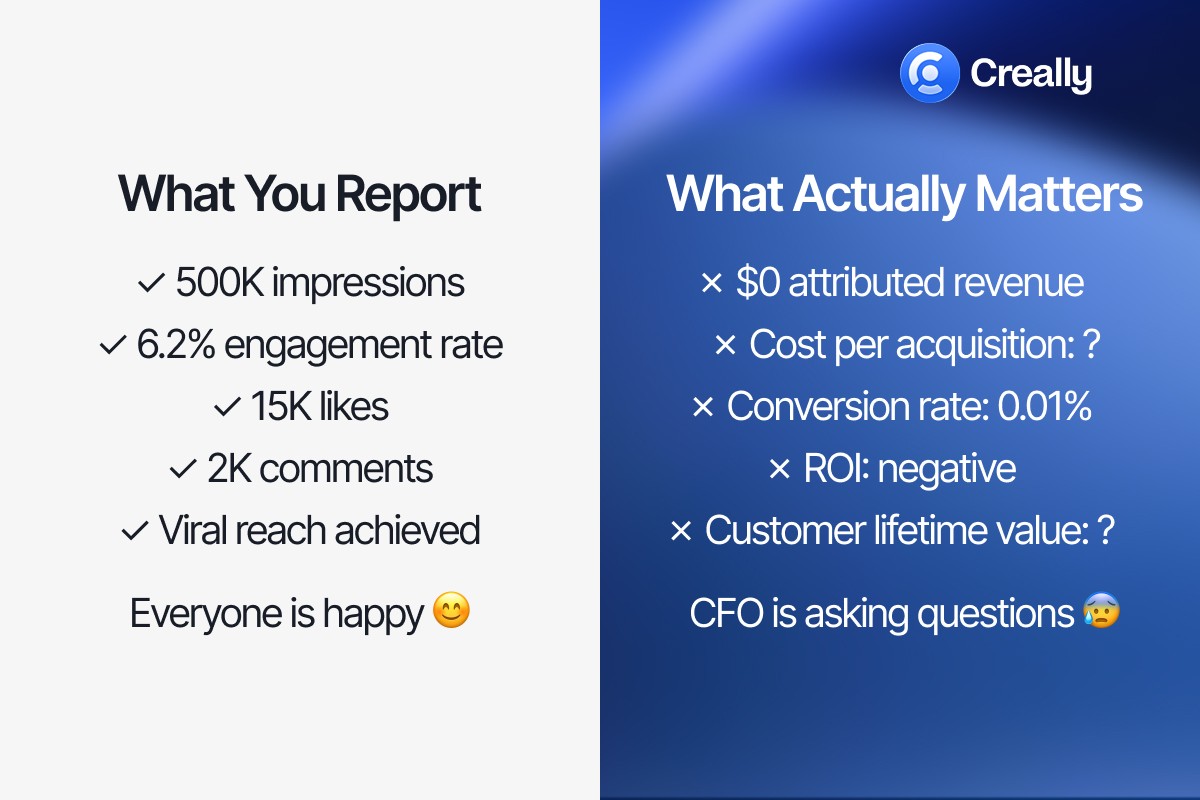
Perhaps the most insidious aspect of engagement metrics is that they create an illusion of precision and control. A 5.3% engagement rate feels scientific, measurable, trackable. It's a number you can put in a report, graph over time, and use to demonstrate progress. This false precision is deeply comforting in an industry often criticized for being fuzzy and hard to measure.
But precision without accuracy is worse than no measurement at all. It creates confidence in decisions that aren't actually supported by evidence. You might celebrate that your engagement rate improved from 4% to 6%, interpreting this as success, while your actual cost per acquisition doubled and revenue attribution declined. The precision of the engagement metric obscured the truth about campaign performance.
This is what makes engagement a comfort metric. It comforts marketers who need something to report. It comforts executives who want evidence that money is being well spent. It comforts creators who want to demonstrate their value. But comfort isn't clarity, and feeling good about your metrics is not the same as knowing whether your marketing actually works.
Moving Beyond Comfort
None of this means engagement is useless or should be completely ignored. Engagement can be a useful diagnostic tool, a signal of content quality, and a leading indicator worth monitoring. The problem isn't that engagement exists, it's that it's been elevated to a position it was never designed to occupy.
Engagement is a process metric, not an outcome metric. It tells you something is happening, but not whether what's happening matters. Building an influencer marketing program that scales requires shifting focus from process to outcomes, from attention to action, from comfort to clarity.
In the next article in this series, we'll explore what real ROI measurement looks like in influencer marketing: how to think about the relationship between views and revenue, what attribution actually requires, and why the goal isn't perfect measurement but good enough measurement to make better decisions. We'll move from diagnosing the problem to building the solution.
For now, the question to sit with is this: Are you measuring engagement because it tells you what you need to know, or because it tells you what you want to hear? The answer to that question determines whether you're building a marketing experiment or a revenue system.
And if you're serious about scale, you need the latter.


