
From Views to Revenue: What Influencer Marketing ROI Really Means

Part 2 of a series on measuring real ROI in influencer marketing.
In the first part of this series, we established that engagement is a comfort metric, something that feels good to measure but fails to tell you whether your influencer marketing actually works. Now comes the harder question: if not engagement, then what?
What does real ROI measurement look like in influencer marketing? And more importantly, what does it actually mean for a campaign to "work"?
This is where most conversations about influencer marketing ROI break down. Marketers throw around terms like "attribution," "incremental revenue," and "brand lift" without a clear definition of what they're actually trying to measure. Finance teams demand proof of return that marketing can't provide with existing tools. And everyone ends up talking past each other, using the same words to mean completely different things.
Before you can measure ROI, you need to agree on what ROI means in the context of influencer marketing. And that's far less obvious than it sounds.
The ROI Definition Problem
Ask ten marketers to define influencer marketing ROI and you'll get ten different answers. Some will talk about reach and impressions. Others will focus on engagement rates or cost per engagement. The more sophisticated ones might mention click-through rates or landing page visits. And a few will actually try to connect it to revenue.
They're all measuring something, but they're not all measuring return on investment.
ROI has a specific meaning: it's the ratio of profit generated to money spent. In its simplest form, it's (Revenue - Cost) / Cost. If you spend $10,000 on a campaign and it generates $30,000 in revenue, your ROI is 200%. If it generates $8,000, your ROI is negative 20%. This isn't complicated math, but it requires knowing two things with reasonable confidence: how much you spent and how much revenue that spending generated.
The first part is easy. You know what you paid creators, what you spent on product seeding, what your platform fees were, what your internal team costs looked like. Calculating total campaign cost is straightforward accounting.
The second part, attributing revenue to specific influencer activity, is where everything falls apart.
Why Revenue Attribution Is Hard (But Not Impossible)
Revenue attribution in influencer marketing is genuinely difficult, and anyone who tells you otherwise is either lying or selling something. The challenges are real and structural:
The attribution window problem
Someone might see an influencer post today, think about it for a week, research the product, read reviews, see a retargeting ad, and finally purchase two weeks later. Which touchpoint gets credit? The influencer content initiated the journey, but the retargeting ad closed it. Standard last-click attribution gives all credit to the ad. First-click gives it all to the influencer. Neither tells the full story.
The cross-device reality
People see influencer content on their phones while lying in bed, then buy on their laptops at work three days later. Unless you have sophisticated identity resolution, these look like two different people, and the connection is lost.
The offline conversion gap
Many influencer campaigns drive online awareness that converts in physical stores. Someone sees a skincare product in a creator's routine, then buys it at Target the next time they're shopping. That revenue is real, but nearly impossible to track back to the specific content that influenced it.
The word-of-mouth multiplier
One person sees an influencer post, tells three friends, and two of them buy the product. The direct view count shows one impression, but the actual influence extended to multiple purchases. Traditional digital attribution captures none of this.
The brand halo effect
Consistent influencer presence builds brand awareness and credibility over time. When someone finally converts, it might be because they've seen your product mentioned by five different creators over three months, not because of any single post. How do you attribute that sale?
These aren't edge cases, they're fundamental characteristics of how influencer marketing works. The awareness-driven, social-proof-based, long-consideration-window nature of influencer content makes clean attribution nearly impossible.
But "nearly impossible" isn't the same as "not worth trying." The goal isn't perfect attribution, it's good enough attribution to make better decisions than you would make using engagement metrics alone.
The Hierarchy of ROI Measurement
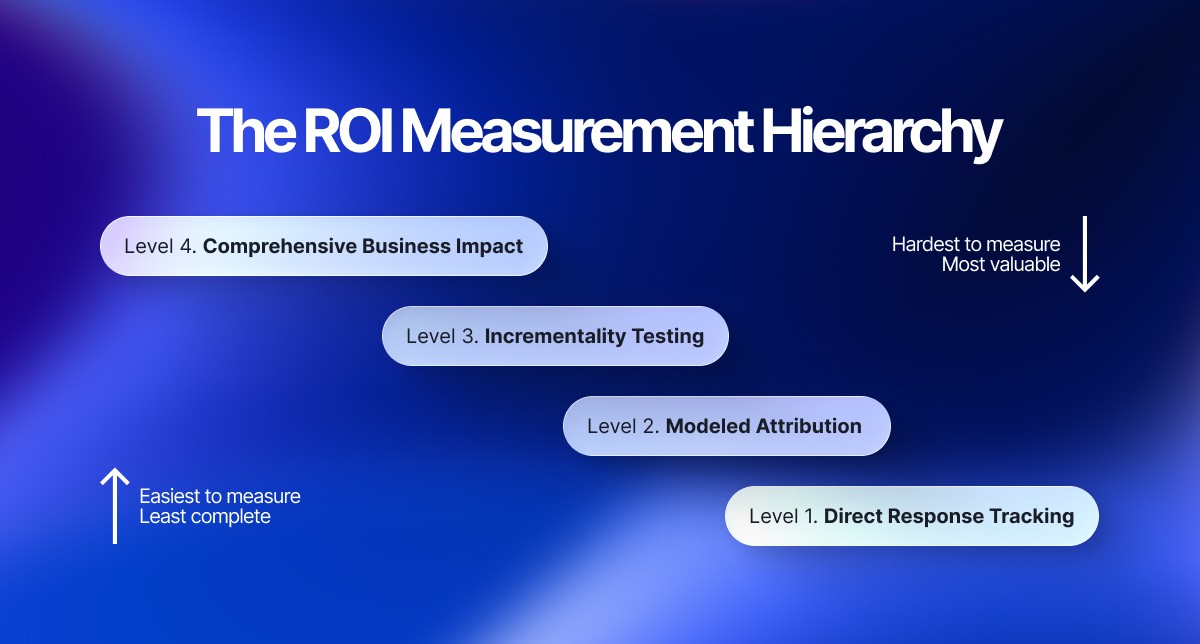
Since perfect attribution is impossible, you need a practical framework for measuring ROI that acknowledges limitations while still providing actionable insights. Think of it as a hierarchy, where each level gets progressively harder to measure but provides progressively more valuable information.
Level 1. Direct Response Tracking
This is the foundation, the minimum viable ROI measurement. You give creators unique discount codes or tracking links, and you measure how many people use them. When someone clicks a creator's link and buys within a reasonable window (usually 7-30 days), you attribute that revenue to that creator.
This is what most brands start with because it's relatively easy to implement. Platforms like Shopify make discount code tracking straightforward. URL parameters let you see traffic sources in Google Analytics. It's not perfect, many people see a creator's content and search for the brand directly rather than using the link, but it gives you a baseline.
The limitation is obvious: this only captures the most direct, easily-trackable conversions. It systematically undercounts influence because it misses everyone who saw the content but converted through a different path. If you spend $10,000 and your tracking links show $15,000 in revenue, your measured ROI is 50%. But your actual ROI might be 150% once you account for untracked conversions.
Level 2. Modeled Attribution
This layer tries to account for the conversions you're not directly tracking. You analyze patterns in your overall sales data and look for correlations with influencer activity. Did site traffic from organic search spike after a major creator posted? Did sales in a specific product category increase following a campaign? Did new customer acquisition accelerate during periods of high influencer activity?
This isn't proof of causation, but it provides supporting evidence. If your direct tracking shows $15,000 in attributed revenue, but you also see a $25,000 increase in organic direct traffic conversions during the campaign window, you can reasonably infer that the campaign drove some portion of those sales.
Multi-touch attribution models try to formalize this by giving partial credit to each touchpoint in a customer's journey. Someone sees an influencer post (first touch), visits your site (site visit), sees a retargeting ad (middle touch), and purchases (last touch). The model assigns a percentage of the sale's value to each touchpoint based on rules you define.
The math gets complicated quickly, and the results are only as good as your assumptions. But modeled attribution at least attempts to account for reality: that most purchases involve multiple touchpoints and influencer content rarely gets full credit in last-click systems.
Level 3. Incrementality Testing
This is the gold standard, the closest you can get to knowing true causal impact. Incrementality testing means comparing what happened with your influencer activity to what would have happened without it.
The cleanest version uses holdout groups. You run influencer campaigns in some geographic regions but not others, then compare sales between test and control regions. Or you show influencer content to a randomly selected portion of your target audience while withholding it from a control group, then measure the difference in conversion rates.
This tells you whether influencer marketing actually caused incremental sales or whether those sales would have happened anyway. If you spend $50,000 on a campaign and sales increase by $100,000 in test regions while staying flat in control regions, you have strong evidence of a 100% ROI.
The challenge is that proper incrementality testing requires sophisticated setup, significant scale (you need enough volume to detect meaningful differences), and time (you need to run tests long enough to account for natural variability). Most brands can't or won't invest in this level of rigor for every campaign.
But even occasional incrementality tests provide invaluable calibration data. If your direct tracking consistently shows 50% ROI but incrementality testing reveals actual ROI of 150%, you know your tracking undercounts by roughly a factor of three. You can use that multiplier to adjust your interpretation of direct tracking data in future campaigns.
Level 4. Comprehensive Business Impact
The highest level transcends individual campaign measurement and looks at influencer marketing's total contribution to business performance. This includes not just immediate revenue but also:
- Customer lifetime value of acquired customers (are influencer-driven customers more valuable than customers from other channels?)
- Brand awareness and consideration shifts (are you reaching new audiences or strengthening perception with existing ones?)
- Cost per acquisition compared to other channels (is influencer marketing more or less efficient than paid social, search, or traditional advertising?)
- Market share movement (is increased influencer activity correlated with gains against competitors?)
This requires integrating data from multiple sources: your CRM to track customer cohorts, brand tracking studies to measure awareness shifts, competitive intelligence to understand market dynamics, and financial models to account for long-term value creation.
Very few companies operate at this level, but those that do can make strategic decisions about whether to scale influencer marketing as a core growth channel or maintain it as a supplementary tactic.
What "Good" ROI Actually Looks Like
Once you have measurement systems in place, you face another question: what constitutes good ROI for influencer marketing?
This is where context matters enormously. A direct-to-consumer brand selling $200 products with 60% margins can afford to accept lower ROI than a marketplace platform that takes a 15% commission. A company optimizing for customer acquisition in a growth phase evaluates ROI differently than a mature brand focused on profitability.
But some general principles apply:
Compare to your other channels
If paid search delivers 300% ROI and influencer marketing delivers 100% ROI, that doesn't necessarily mean influencer marketing is failing, it means it's less efficient than search. But if influencer marketing reaches a different audience or drives higher lifetime value customers, the 100% ROI might be more strategically valuable.
Account for scale limitations
Some channels perform brilliantly at small scale but can't grow. If you can spend $1 million per month on influencer marketing at 150% ROI, that's often more valuable than spending $100,000 per month on a niche channel at 300% ROI. Total profit matters more than percentage return.
Factor in strategic benefits
Influencer marketing often creates assets (content, relationships, social proof) that have value beyond immediate sales. A creator testimonial becomes marketing collateral. An influencer relationship opens partnership opportunities. Positive community sentiment makes future launches easier. These benefits are real even if they don't show up in direct ROI calculations.
Consider maturity curves
Early campaigns often have lower ROI as you're testing creators, learning what content works, and building measurement systems. ROI typically improves as you optimize based on data. A 50% ROI in month one might become 200% ROI by month twelve as you identify high-performers and cut underperformers.
As a rough benchmark, most sophisticated e-commerce brands expect 150-300% ROI from mature influencer programs when using direct attribution, with the understanding that actual ROI including untracked conversions is likely higher. But your specific target depends entirely on your business model, margin structure, and strategic priorities.
The Attribution Honesty Gap
Here's an uncomfortable truth: even with sophisticated measurement systems, you will never know the exact ROI of your influencer marketing with perfect precision. There will always be attribution gaps, untracked conversions, and measurement limitations.
The question is whether you let that uncertainty paralyze you or whether you build systems that give you enough confidence to make good decisions.
Too many brands fall into one of two traps. The first trap is perfectionism: "We can't measure ROI perfectly, so we'll just stick with engagement metrics." This is choosing comfort over clarity, and it guarantees you'll never scale effectively.
The second trap is false precision: "Our dashboard says this campaign delivered exactly 247% ROI." This ignores all the attribution limitations we've discussed and treats modeled estimates as gospel truth.
The right approach acknowledges uncertainty while still driving toward better measurement: "Our direct tracking shows 180% ROI, we know this undercounts actual impact, our incrementality test suggests the true number is probably 250-300% ROI, and compared to our other channels this performance justifies continued investment and testing."
This is what measurement maturity looks like. Not perfect numbers, but honest ones. Not false precision, but useful ranges. Not comfort metrics that hide reality, but imperfect metrics that illuminate it.
From Measurement to Optimization
Understanding what ROI means and how to measure it is necessary but not sufficient. The real value of ROI measurement comes from what it enables: systematic optimization.
When you measure engagement, you optimize for engagement. You find creators with high engagement rates, create content that generates reactions, and celebrate when the numbers go up. But you have no idea if any of this drives business results.
When you measure revenue attribution, everything changes. You can now answer questions that actually matter:
- Which creators drive the most revenue per dollar spent?
- What types of content convert best?
- How does performance vary by product category, audience demographic, or seasonal timing?
- Which creator relationships should you deepen and which should you end?
- Where should you allocate incremental budget for maximum return?
This is the shift from art to science, from gut feeling to data-driven decision making. You stop choosing creators based on follower counts and start choosing them based on proven revenue performance. You stop creating content based on what feels authentic and start creating content based on what actually converts while still feeling authentic.
The brands that have scaled influencer marketing into eight-figure revenue channels didn't get there by having perfect measurement. They got there by having good enough measurement to know what was working and doing more of it while cutting what wasn't.
Setting Up for Success
If you're ready to move from engagement metrics to real ROI measurement, the practical implementation starts with three foundational steps:
First, implement direct tracking
Give every creator unique discount codes or UTM-tagged links. Set up proper attribution windows in your analytics (30 days is standard, but test what makes sense for your consideration cycle). Ensure your e-commerce platform or CRM can connect purchases back to creator sources. This gives you the baseline data you need.
Second, establish your measurement framework
Decide which level of the ROI hierarchy you're targeting and what resources you'll commit to it. Be honest about your limitations. If you're a small brand without data science resources, focus on nailing Level 1 and 2. If you have scale and sophistication, invest in incrementality testing.
Third, define your success metrics and targets
What ROI threshold makes influencer marketing worth scaling for your business? How will you compare influencer performance to other channels? What time frame will you use to evaluate success? Having clear targets in advance prevents the goal-post-moving that happens when campaigns underperform.
The specific tools and platforms you use matter less than the discipline of consistent measurement. Some brands build custom dashboards. Others use influencer marketing platforms with built-in analytics. What matters is that you're tracking revenue, not just engagement, and you're using that data to make decisions.
The Honest Conversation About ROI
Moving from engagement to revenue measurement requires having honest conversations, with your team, with executives, and with the creators you work with.
With your team: "We've been celebrating engagement wins, but we don't actually know if we're making money. That changes now. We're going to implement better tracking, and some campaigns that looked successful might turn out not to be. That's okay, we're learning."
With executives: "Our ROI measurement won't be perfect. There will be attribution gaps. But it will be dramatically better than what we have now, and good enough to make smart allocation decisions. Here's what we're implementing and here's the confidence level we'll have in the results."
With creators: "We're moving to performance-based evaluation. We'll still value authentic content and creative freedom, but we need to see business results. Here's how we'll track performance and here's how it affects our partnership decisions."
These conversations are uncomfortable but necessary. The alternative is continuing to operate in the comfortable fog of engagement metrics while your actual business performance remains unknown.
What's Next
Understanding what ROI means is critical, but it's still conceptual. In the next article, we'll get tactical: the specific systems, tools, and processes for implementing revenue attribution in practice.
We'll cover tracking infrastructure, attribution models, technical challenges, and dashboards that drive decisions. We'll address creator resistance to tracking links, multi-creator campaigns, and measuring awareness-focused content.
Because knowing you should measure ROI is one thing. Actually doing it is another.
The gap between engagement and revenue is real but not insurmountable. It just requires facing reality rather than hiding behind comfort metrics. As we'll see in Part 3, practical implementation is more accessible than most marketers assume.
For now, start asking the question that matters: not "how much engagement did we get?" but "how much revenue did we generate, and how do we know?"
That question changes everything.


